History of Development

YUPO began its journey in May 1969 as an innovative manufacturer of synthetic paper.
Since then, we have grown alongside the development of the synthetic paper industry to become a leading manufacturer,
expanding our business globally on the strength of the proprietary technologies we have built over many years.
Here, we will introduce the development history of our synthetic paper, a "dream material" born from an ongoing pursuit of limitless possibilities.
1967

Development of early synthetic paper
Background of the birth of synthetic paper
From the demands of the times to a major boom
In response to the depletion of forest resources caused by increasing consumption of wood and the rise of the petrochemical industry, in May 1968, the Resources Council of the former Science and Technology Agency of Japan issued its "Recommendations Regarding the Fostering of the Synthetic-Paper Industry." The recommendations emphasized the importance of synthetic paper manufactured from inexpensive petroleum resources as a substitute for natural paper and presented an ambitious outlook: of the estimated demand for 16 million tons of paper projected for a decade later in 1978, synthetic paper could account for roughly 3.5 million tons.
In 1967, even before this recommendation had been issued, Mitsubishi Petrochemical Co., Ltd. (now Mitsubishi Chemical Corporation) established a materials laboratory and synthetic paper group. Development of synthetic paper based on polypropylene, a technology that had been steadily advancing, was already underway.
Estimated paper demand and potential market volume
for synthetic paper in Japan
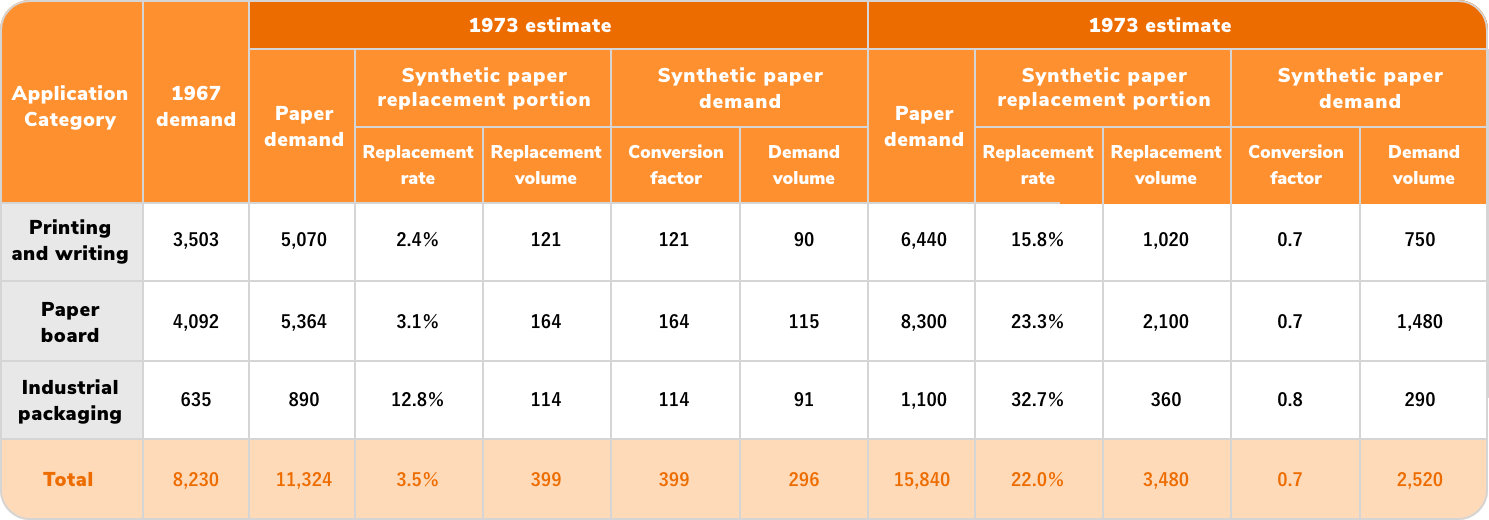
Source: Prepared based on Recommendation No.21 of the Resources Council,
Science and Technology Agency
(Unit: 1,000 tons)
Meanwhile, Oji Paper Company (now Oji Holdings Corporation), which had previously conducted research on styrene paper and related materials, was inspired by the government's recommendations and held the first meeting of the Synthetic Paper Project Team in September 1968.
By the autumn of 1970, an estimated 20 companies were planning to commercialize synthetic paper, triggering a major boom that drew in related industries such as petrochemicals, paper pulp, and textiles.
1968

Surface with micro-void formation
Innovation in synthetic paper
The groundbreaking discovery of micro-voids
Initially, the Mitsubishi Petrochemical Synthetic Paper Group sought to obtain a paper-like polypropylene film by adding white pigments and inorganic fillers to polypropylene. The goal was to achieve whiteness through white pigments, and writability and printability by creating surface roughness using inorganic fillers.
However, when prototypes were made using white pigments, the resulting film had a specific gravity of around 1.2, which was too high, and also showed poor writability. The researchers were unable to achieve the synthetic paper performance they were seeking.
Then, in 1968, a serendipitous discovery changed everything. When a film was produced without adding white pigment to polypropylene, a white film without white pigment was obtained. Upon investigation, it was found that countless microscopic voids, or micro-voids, and fine cracks had formed on the film's surface. These micro-voids scatter light, which creates the white appearance. The fine surface cracks also improved writability and printability, and the micro-voids reduced the specific gravity to a paper-like level (from 1.2 down to 0.77).
Thus, a synthetic paper with micro-voids and a structure entirely different from that of other synthetic papers was born. The first basic patent for our synthetic paper was filed on March 26, 1968, approximately two months before the recommendations of the Resources Council of the Science and Technology Agency of Japan were issued.
The "Fukuro (owl) Unit"
A group of young researchers driven by a passion for synthetic paper development
At the time, the Synthetic Paper Group did not have its own development equipment, so it rented equipment from the film lab to conduct experiments. Experiments could only begin around 4:00 p.m., after other research teams had finished their work. Once experiments were completed, the equipment had to be meticulously cleaned. Even small traces of synthetic paper material could interfere with research on transparent films. The machines were dismantled and carefully wiped down, after which the piled-up prototypes had to be loaded onto handcarts and transported to a warehouse more than a kilometer away. Night after night, the handcarts would pass by the guardhouse well past midnight.
Before long, the group came to be known as the "Fukuro Unit." "Develop a unique synthetic paper with a unique structure"--this was their guiding principle. With an average age of just 21 and consisting of around ten members, the Fukuro Unit devoted itself tirelessly to research for four years in pursuit of bringing synthetic paper into existence, until they relocated to the Kashima Unit 1 plant.
1969

Opening ceremony of the Oji-Yuka Synthetic Paper Research Institute
Partnership between leading paper and petrochemical manufacturers
The launch of the synthetic paper business
"Develop a petrochemical-based synthetic paper that offers economic efficiency and quality equal to or superior to natural paper and that has the growth potential for mass production."
On February 12, 1969, Oji Paper Company and Mitsubishi Petrochemical Co., Ltd., both of which had been conducting their own research into synthetic paper, reached an agreement to unite their efforts through joint research. On May 10, 1969, Oji-Yuka Synthetic Paper Research Institute Co., Ltd. (now YUPO Co., Ltd.) was established.
Four development teams were formed at the new company, including a team dedicated to "FP Paper," the synthetic paper utilizing the micro-void structure described earlier. With this structure in place, we aimed to expand into a wide range of paper-related fields.

Scene from the completion ceremony of Kashima Factory Unit 1
Between 1968 and 1969, we filed foundational patents in Japan and across Europe and the United States for the manufacturing technology of "FP Paper." Media outlets soon reported that a "dream paper" had been developed at Oji Yuka, prompting a flood of inquiries from roughly 150 companies in Europe and North America.
In 1970, the year following the establishment of the company, Oji-Yuka Synthetic Paper Co., Ltd. was founded to carry out industrial production. By the end of June 1971, the first synthetic paper plant, with a production capacity of 6,000 tons per year, was completed in the Kashima Coastal Industrial Zone in Ibaraki Prefecture.
At the time, conventional stretching plants and processes were designed for thin films of around 20-30 microns. Synthetic paper, however, exceeded 100 microns in thickness. As a result, the original plant design struggled to accommodate such thickness, and extensive modifications were required to enable the stretching of thicker materials. Despite these challenges, through tireless efforts, we successfully started up a plant capable of stable synthetic paper production.
1971
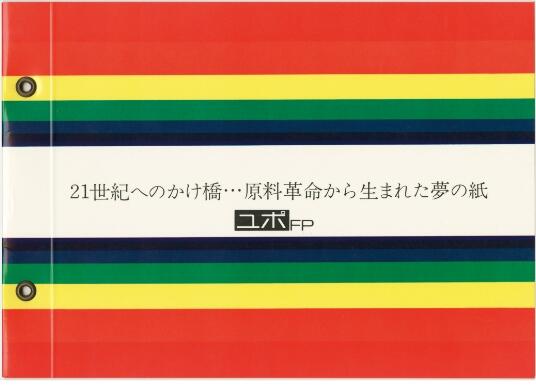
Early sample book
Naming and launch of the "YUPO" brand
On October 20, 1971, "YUPO" was announced as the product name for FP Paper. The name was selected from about 3,000 submissions gathered from employees of both parent companies and their families. Following a review by a selection committee that included Sakyo Komatsu and Shinichi Hoshi, "YUPO," which later became the company name, was chosen (click here for the origin of the name).
In December, YUPO saw its first commercial applications in shopping bags and stickers. In January of the following year, it began to be adopted for maps and vegetable binding tapes. As YUPO gained wider acceptance, efforts to develop new applications accelerated. This led to the successful development of translucent YUPO, expanding the product lineup, while also marking the start of joint development initiatives for secondary processing technologies for synthetic paper.
1973

Affiliated overseas paper manufacturers visiting Kashima
From volume to quality amid the oil shock
A 180-degree strategic shift
Just as partnerships with overseas paper manufacturers had been established and exports to the United States were beginning, an unexpected and dramatic event occurred: the first oil crisis, triggered by the outbreak of the Yom Kippur War in October 1973. By December, prices of key raw materials had surged sharply. The original premise of "producing substitutes for natural paper from inexpensive petroleum" collapsed, forcing many synthetic paper manufacturers to withdraw from the market on profitability grounds.
Amid increasingly severe conditions across the industry, we chose to continue operations, albeit on a slimmer scale, recognizing the potential of our unique functional strengths. We shifted our sales strategy away from positioning synthetic paper as a substitute for natural paper, instead focusing on high-performance applications that natural paper could not achieve. With this shift, YUPO relaunched itself as an advanced new material combining the characteristics of synthetic resin film and paper, although there was a significant price difference compared to natural paper.
1978

Growing adoption overseas
Quality improvement through a comprehensive overhaul of YUPO
Under this new strategy, market development progressed by leveraging YUPO's distinctive functions. New applications were developed in fields such as commercial printing, adhesive paper, specialty paper, bags and envelopes, packaging, and building materials. By around 1978, demand had begun to stabilize. At this point, aiming for further growth and wider adoption, we embarked on a comprehensive overhaul of YUPO. This initiative sought a fundamental solution to the long-standing issue of aging-related degradation and required major changes to raw materials and manufacturing processes.
These changes involved significant risk: once implemented, there would be no turning back. However, the result was a substantial improvement in quality, including weather resistance and die-cutting performance. Pre-sales began with selected grades, and in 1981, the full transition was completed. The product was launched as "YUPO FPG," which remains the foundation of today's YUPO.
Supported by this major quality improvement, we achieved our first profitable year in 1981, more than ten years after our founding.
1979

Commemorative photo after winning the Mainichi Industrial Technology Award
Winner of the Mainichi Industrial Technology Award
In 1979, in recognition of their outstanding contributions to the successful development and industrialization of synthetic paper manufacturing technology, Koji Onishi, a part-time director of the company (Oji Paper Vice President), and Naoichi Takashima, President of the company (Managing Director at Mitsubishi Petrochemical)*, received the 30th Mainichi Industrial Technology Award. This honor marked a major milestone for the company, which had pioneered synthetic paper and opened up an entirely new market, and it became a powerful driving force for subsequent business growth.
- * Naoichi Takashima later received the Blue Ribbon Medal in 1991 for the "Development of Synthetic Paper Manufacturing Technology."
~2025

"YUPO forever"
At the Kashima Factory stands a stone monument bearing this message from Shigeru Tanba,
former Chairman known as the "Father of YUPO," who contributed to the company for nearly 40 years, from YUPO's birth through commercialization and subsequent growth.
YUPO's challenges and expansion
Born out of the needs of the times, YUPO has continued to open up diverse applications in step with changes in society through ongoing technological innovation. Building on our core technologies, we have created products that go beyond conventional expectations: YUPO that is printable with standard inks, translucent YUPO, water-absorbing YUPO, and YUPO with micro-suction functionality. By responding to needs around the world and working together with customers, we continue to create new value and expand the possibilities of materials.
2026

Rebranding
Having pioneered the synthetic paper market, comprising materials that combine the characteristics of both paper and film, we will take a new step forward in July 2026 as a company dedicated to the development and sale of creative substrates.
Guided by our core philosophy of "Value Co-Creator," we have built a structure focused on solving customer challenges. As a close and trusted partner in everyday life, we will continue to create new value together with our customers.