CORE TECHNOLOGIES

Basic Structure of YUPO
Multi-functionality and versatility enabled by a proprietary, multi-layer structure and technology.
YUPO is a creative substrate that combines functionality with expressive performance.
By integrating its proprietary multi-layer structure with advanced surface-treatment technologies, YUPO achieves levels of functionality and visual performance that were not possible with conventional materials.
Each layer plays a distinct role, allowing YUPO to balance properties that are often contradictory, such as functionality and visual appeal, or strength and flexibility. By layering diverse technologies, YUPO serves as a creative substrate that supports and expands our customers' creativity.
YUPO's multi-layer structure (basic structure)

By combining the multi-layer structure with specialized coatings,
YUPO delivers a wide range of functions and effects.
A material platform that enables diverse technological developments.
YUPO Easy Separate

When removal is attempted, only the surface layer of the label peels away while the back side remains on the substrate, helping prevent counterfeiting.
YUPO Aqua

While maintaining water resistance and durability, one side provides water-absorbing functionality, allowing the use of various types of adhesives.
YUPO Octopus

The micro-suction layer allows the material to be applied to smooth surfaces and removed cleanly without adhesive residue.
YUPO Metalized

One side is finished with an aluminum vapor-deposited metallic surface, offering both high functionality and visual appeal.
Basic Manufacturing Method of YUPO
A proprietary process supported by numerous patents worldwide
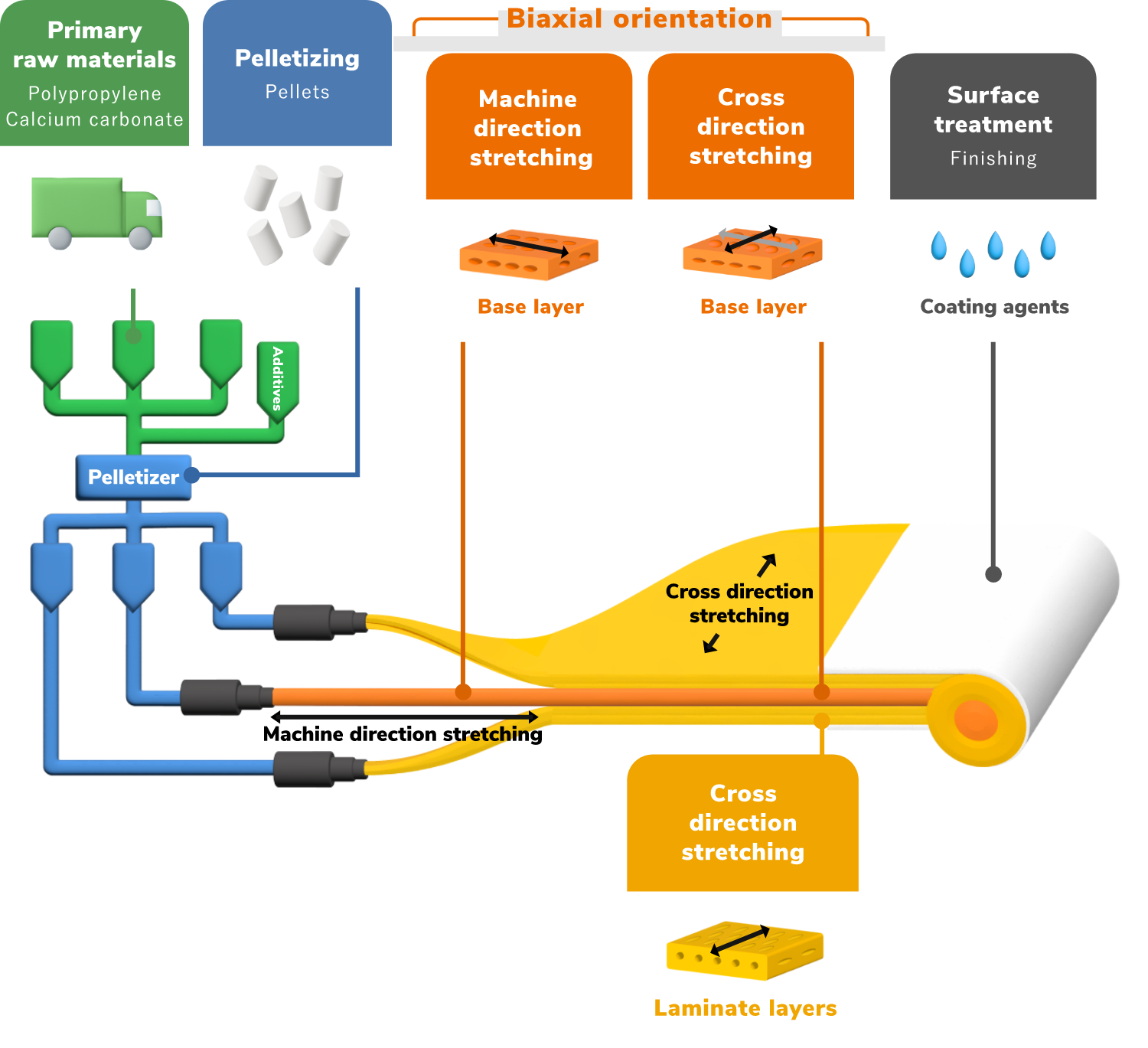
YUPO's multi-layer structure is produced using a proprietary biaxially oriented film-forming process. The base layer is stretched in both the machine direction and cross direction, while the laminate layers are stretched in the cross direction. A wide range of patents related to this process have been obtained in Japan, China, the United States, Europe, and other regions.
The primary raw materials are polypropylene resin and calcium carbonate (an inorganic filler), combined with small amounts of additives. During biaxial orientation, micro-voids (micro-scale cavities) are formed as the film is created. By combining the multi-layer structure, consisting of a base layer and functional laminate layers, with surface treatment, YUPO achieves complex, integrated functionalities that cannot be realized with a single-layer material.
Manufacturing process (illustrative)
Integrated In-House Manufacturing
The in-house production system enables product design tailored to customer needs and a consistent supply of high-quality products.
While many companies increase productivity through specialization and outsourcing, YUPO achieves a balance of high added value, productivity, and quality consistency through fully integrated manufacturing.
By producing a wide variety of products on the same production line and combining this with recycling technology that returns scrap to raw materials, we enable diverse product development while reducing environmental impact.
Integrated production process
Base layerBiaxial orientation
Designing the base layer that
forms the foundational properties of YUPO's materials,
such as durability and water resistance.

Laminate layersUniaxial orientation
Adding various functional
properties and adjusting stiffness
according to the application.

Proprietary surface treatmentSurface treatment
Applying YUPO's proprietary
coating formulations to enhance
printability and surface expression.
YUPO product development with the customer in mind

- Customization tailored to customer requirements
- Post-manufacturing support system
- Commitment to reducing environmental impact
Basic Structure of YUPO
Lightness and whiteness created by micro-voids
With YUPO, the base layer, which is stretched in two directions, provides strength and rigidity, while the laminate layers, which are stretched in the cross direction, contribute texture and functionality. One of the defining features that gives YUPO its unique properties is the formation of countless micro-voids (micro-scale cavities) during the stretching process, with calcium carbonate acting as the nucleus.
These micro-voids scatter light, giving the material a bright white appearance and high opacity, while also contributing to reduced weight. In addition, the fine surface structure enhances ink adhesion and writability.
Mechanism of micro-void formation
Micro-voids are formed during the stretching process, originating around particles of calcium carbonate.

Effects of micro-voids
By designing micro-voids both on the surface and within the interior, YUPO achieves the functional characteristics of both film and paper.

Expanding the Technology
YUPO's core technologies and their application across diverse uses
Through proprietary raw material selection and formulation technologies, YUPO collaborates with a wide range of partners, including the Mitsubishi Chemical Group, while also incorporating expertise from the Oji Group in surface treatment and print performance evaluation. This allows us to accumulate advanced technologies that would be difficult for a standalone film manufacturer to achieve alone.
In addition, YUPO maintains close technical collaboration, built on long-standing trust, with external partner companies that perform secondary processing of YUPO products, further expanding their functionality.
Core technologies
Synergy with group companies
Mitsubishi Chemical Group
Oji Group
Partner collaboration
Processing companies and research institutions
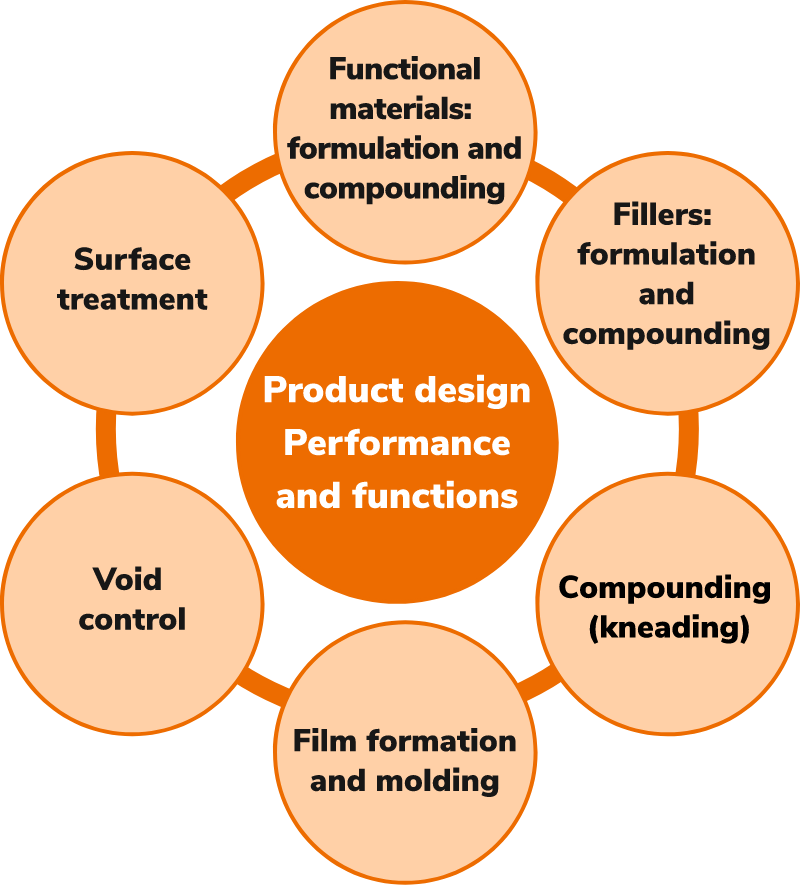
Functional properties
By leveraging these capabilities, we design products
tailored to specific needs and provide a wide range of solutions.
- Fast drying
- High reflectivity
- Heat retention
- Destructible
- Self-adhesion
- Air permeability
- Translucency
- Solvent absorption
- Water Absorption
- Tear resistance
- Heat Sealable
- Thermal insulation
- Easily torn by hand
- Decorative appearance
- Oil absorption
Applications
YUPO has a strong track record not only in printing applications
but also in non-printing uses such as industrial substrates. For details, please contact us.
-
Printing and publishing
Posters, catalogs, and book covers that leverage excellent printability and durability.
-
Packaging and labels
Label base materials and food packaging materials that combine water resistance with adhesion.
-
Industrial and manufacturing
Industrial substrates requiring durability in harsh environments.