
SAFETY AND THE ENVIRONMENT

Safety and environmental philosophy and basic policies
Safety and environmental philosophy
- Safety is the foundation of our existence. Safety always takes precedence over everything else.
- Our mission is to protect the global environment and contribute to the realization of a sustainable society.
Safety and environmental policies
- Comply with all social rules, including laws and corporate ethics.
- Pursue zero accidents and zero occupational injuries.
- Reduce environmental impact in collaboration with customers and affiliates to prevent global warming and protect the natural environment.
- Develop human resources capable of taking proactive action through safety and environmental education.
- Foster trust and understanding through continuous dialogue with society.
- Drive continuous improvement by utilizing the latest technologies, as well as internal and external information.
Safety initiatives
1Eliminating safety incidents and occupational injuries
Workplace accident prevention
To prevent occupational injuries, we maintain a rigorous management system compliant with OHSAS18001:2007 requirements. We engage in safety activities based on analyses of past accidents and near-miss incidents.
All employees participate in these safety activities through our improvement proposal system. We will continue to operate with safety as the absolute priority by conducting risk assessments and ensuring the proper use of protective equipment.
2Cultivating and sustaining a culture of safety
Developing a culture of safety
While the Kashima Factory and Yupo Papier have always strived to create safe and comfortable workplaces, in FY2024, we also introduced a "Safety Culture Diagnosis," supervised by Niigata University, to further strengthen our safety efforts. By periodically and quantitatively identifying our strengths and weaknesses through these diagnoses, we aim to build an even safer and more supportive work environment.
Environmental initiatives
We are committed to protecting our water, forests, air, and the people who call Earth home.
Driven by this commitment and represented by the YUPO Environmental Logo, we will continue our mission to contribute to society through environmental conservation and the reduction of our environmental footprint.
The four missions of YUPO
1Prevention of environmental
pollution

We strive to prevent pollution by adhering to all laws and regulations, as well as our own rigorous voluntary standards, which are subject to regular review and continuous improvement.
2Advancement of climate
change countermeasures
We are committed to reducing CO₂ emissions by actively improving production efficiency and implementing energy-saving measures across our manufacturing facilities.
3Promotion of
recycling
We promote the recycling of our products throughout the supply chain and advocate for the effective utilization of recycled materials sourced externally.
4Development of eco-friendly
technologies and products

From the earliest stages of research and development, we create technologies and products that prioritize safety, environmental impact reduction, and responsible resource consumption.
1Prevention of environmental pollution
Environmental conservation initiatives
We engage in environmental conservation as a corporate priority, not only by complying with laws and regulations but also by developing products that reduce environmental load and quantitatively evaluating the environmental impact of our production processes. We have maintained ISO 14001 certification since 2000.
2Advancement of climate change countermeasures
Tracking and reducing GHG (greenhouse gas) emissions
To take on the challenge of realizing a future decarbonized society, we are working to understand and track GHG emissions across our entire global supply chain.
For Scope 1 and Scope 2 emissions related to our manufacturing processes, as well as for Scope 3 Category 1, we have continuously undergone third-party verification* in accordance with ISO 14064-3, including YUPO America, since FY2022.
Based on these verified results, we are striving to reduce emissions through measures such as productivity enhancements and equipment upgrades, thereby moving us closer to our goal of achieving net zero by 2050.
-
FY2022201,780(Mt-CO₂e)
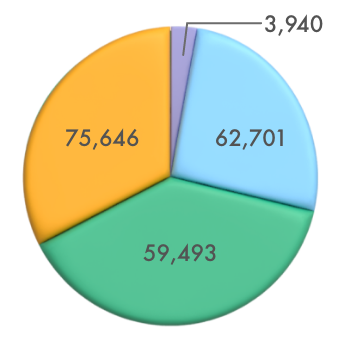
-
FY2023169,139(Mt-CO₂e)
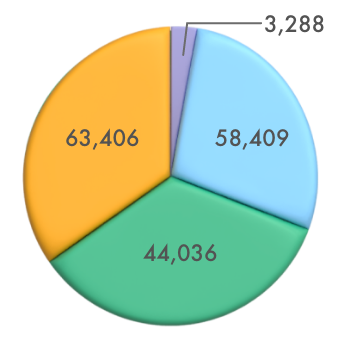
- Scope.1
- Scope.2
- Scope.3 Category.1
- Scope.3 Category.2-15
* Emissions figures represent the combined total for YUPO and YUPO America.
Greenhouse gas emissions
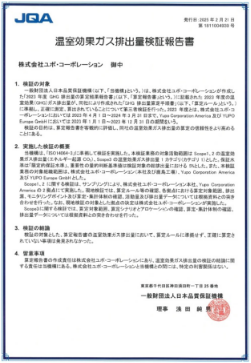
verification report
3Promotion of recycling
Promoting product recycling and the use of recycled materials
We aim to realize a circular economy through manufacturing by advancing the use of recycled resources.
Recycling of election ballot paper
On February 19, 2025, we launched "Election Ballot Recycled R-25 Business Cards," which achieve a recycled material ratio of over 70% by combining 25% recycled resin derived from used ballots with post-industrial recycled (PIR) materials.
- * Post-industrial recycling: The reuse of materials generated during the manufacturing process before they reach the consumer.

Initiatives utilizing the wide-area certification system
We utilize the wide-area certification system to collect used YUPO disposed of by our customers.
Through material recycling (including chemical recycling), we promote the reuse of used YUPO. We contribute to creating a circular economy through "koto-zukuri" (value creation).

4Development of eco-friendly technologies and products
Promoting reduced environmental impact across the entire supply chain
We contribute to a sustainable society and the reduction of our environmental footprint through the development of eco-friendly products.
Developing products that lower CO₂ emissions
and reduce waste
Biomass resin blended products
We reduce CO₂ emissions (on a raw material basis) by replacing fossil fuel-derived resins with plant-derived biomass resins.
What is biomass resin?
Biomass resin is a plastic derived from plants such as sugarcane. Because plants absorb atmospheric CO₂ through photosynthesis as they grow, the CO₂ emitted when the material is eventually incinerated as waste can be considered net-zero.

by many companies.
Development of biomass resin blended products

YUPO Air
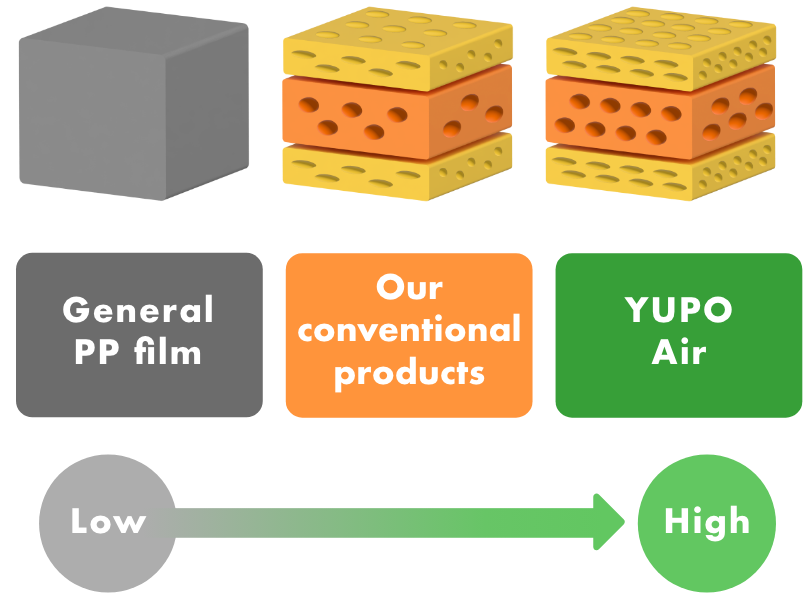
A product that contributes to reducing plastic consumption and CO₂ emissions.
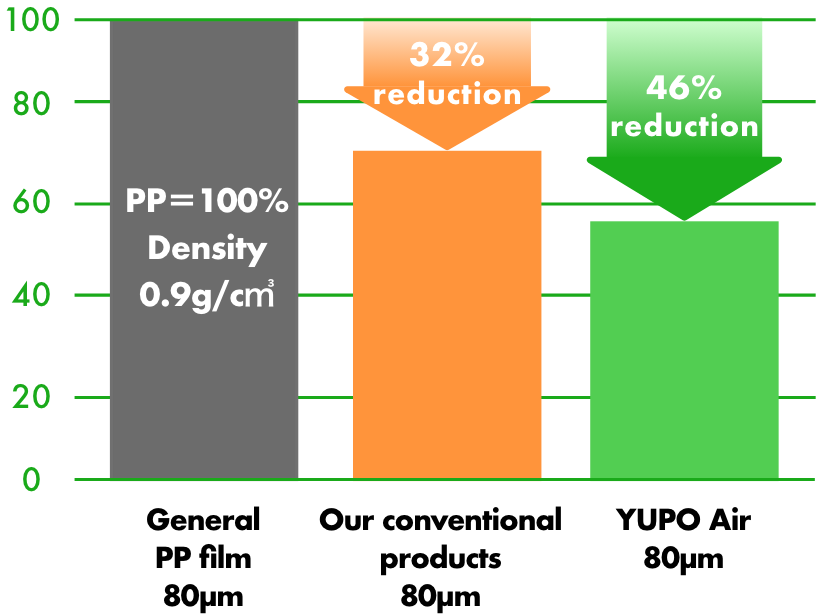
Reduces plastic consumption and CO₂ emissions through proprietary micro-void control technology. Reduces plastic consumption by approximately 46% compared with general polypropylene (PP) film (comparison based on identical thickness and area).
Plastic consumption
Void volume
YUPO In-Mold
Compared to adhesive or shrink labels,
YUPO In-Mold reduces processing steps and energy consumption, leading to lower CO₂ emissions.
In-mold decoration bonds the label to the container simultaneously during the molding process. With fewer steps than conventional labeling methods, it contributes to a reduction in CO₂ emissions.
In-mold blow molding
STEP.1
The pre-printed label is
placed inside the mold.

STEP.2
The label position is secured
using suction or static electricity.

STEP.3
The cylindrical molten resin
is clamped within the mold.

STEP.4
The cylinder is inflated using
air pressure to form the container.

STEP.5
The label bonds to the molded
container, completing the decoration.

In-mold
injection molding
STEP.1
The pre-printed label is placed inside the mold.
The label position is secured using suction or static electricity.

STEP.2
The mold is closed and
molten resin is injected
into the cavity.

STEP.3
The molded product is removed
after cooling to complete
the decoration.

Development of labels that detach easily during recycling
Official certification obtained from APR*1
Planned international expansion under the brand name "YUPO CleanSort"
By combining proprietary blending and lamination technologies with micro-void control, we facilitate the recycling of plastic bottles.
These labels can be peeled off and separated during the recycling process even if consumers do not remove them at the time of disposal, preventing ink and label fragments from contaminating the recycled material. Furthermore, because no adhesives are used, this method is effective in preventing the contamination of wash water used during recycling.
This technology contributes to the production of high-quality recycled plastic materials (PCR*2).
*1 APR (Association of Plastic Recyclers): A major organization in the North American plastic recycling industry that provides evaluation and certification for the recyclability of plastic products and packaging.
*2 PCR (Post-Consumer Recycled): Materials recovered and regenerated from products that have been used and disposed of by consumers.
Recycling process
CleanSort for HDPE bottles
Collection

Collect bottles with labels attached
Pulverization

Labels detached from bottles via the shearing force generated during pulverization
Air classification

The pulverized bottle flakes and YUPO labels are completely separated.
Reprocessing

High-grade PCR material can be obtained using only high-purity pulverized bottle material.
CleanSort for PET bottles

Maintenance and management of product safety
Policies for maintenance and management
We develop and sell a wide range of products. The development of new products often requires the adoption of new raw materials. To ensure product safety, we investigate the presence of regulated chemical substances and maintain compliance with the Food Sanitation Act when adopting new materials. This process is based on information transmission schemes such as chemSHERPA, which align with various domestic and international regulations, as well as our own internal voluntary standards. We only use raw materials that meet these voluntary standards.
Furthermore, as chemical substance regulations are established or revised globally and the number of regulated substances increases, we strive to continuously monitor these changes. We maintain and manage product safety by confirming the compliance status of our products and taking necessary measures as required.
Communication of product safety information
With the rise in global environmental awareness, the environmental compliance of products has become an essential factor alongside quality and cost. Accurate communication regarding regulated chemical substances contained in products is indispensable for ensuring that customers use our products safely and appropriately.
We provide product safety information through AIS and conduct investigations and provide answers to inquiries regarding product safety, including substances contained in our products.
Provision of Article Information Sheets (AIS)
Since 2013, we have made the AIS for our major products available on our website.
We will continue to disseminate information regarding product safety to ensure that our customers can use our products with peace of mind.